Thursday, 2 June 2016

Abortion legalized for some special cases

Abortion legalized for some special cases 

The Supreme Court had given permission to abort under special circumstances to a rape victim some time back. Whereas high courts and session court had negated this permission as she was in later months of pregnancy, which was above the legalized period of abortion. Let us know more.

Supreme Court had given a historical judgment in which a 14-year-old rape victim was given permission to abort her 26 weeks issue. Also another statement was given in which it was clarified that this is not applicable in normal cases. Also, it should known that the Draft Medical Termination of Pregnancy Bill 2014, clarifies that an issue of 20 to 24 weeks can be terminated only when there is no big risk to the carrying mother.

The High court had denied the abortion of the above said rape victim and thus the Supreme Court had to give their verdict. Many cases of abortion come to the court. Haresh and Nikita Mehta had pleaded for abortion in 2008 at Mumbai High Court. She was carrying a 26-month-old issue, which had heart problems. High Court had denied the plea saying that there is no guarantee that the doctor did not say that after being born the child will have any big disease. 

The right to abort come sunder right to living for women. This should be granted in special conditions to the women. There are such cases in which abortion seems the better and correct solution like severe threat to the health of the mother or if it is confirmed in test that the child has some rare disease. There have been many such cases presented to the Court and there the court has not gone by the books of law but by a judicious mind.
We have a law regarding abortion. It is called medical termination of pregnancy act 1971. In normal cases, abortion is allowed between 12 to 20 weeks of the issue. This law is 45 years old and is based on the tests of those times. The law states that abortion can be carried only as under said circumstances-

·    When it is a threat to life of the mother.
·    The mother could have physical or mental problems because of the issue.
·     When the pregnancy is due to rape.
·     When the child is not developed and prone to be a handicap.
·    When abortive measures of both husband and wife or one of them has failed.
·     An issue of 12 weeks can be aborted with the advice of a gynecologist.
· For an issue of 12 to 20 weeks advice of at least two gynecologists is necessary.


International covenant on civil and political rights section 6 (1) states that It is not permitted to take away someone’s life as per our whims and fancies. A women’s right to living is related to right to abortion. The case of Savita Halappan in Ireland who was not permitted to abort and after which she passed away. This act was opposed all over the world. 


By Nandita Jha, High Court Advocate Delhi 

Monday, 25 April 2016

Security measures can be taken by women to save the evidence

These security measures can be taken by women to save the evidence

Every day we hear of eve teasing, bad behavior, and rape cases against women. Sometimes when the complaint is registered at a later period the evidence gets lost and the victim does not get justice. Also sometimes, such evidence are kept to frame someone. Such evidence is tested in medical laboratories and thus are decided whether the victim is telling the truth. The victim in cases of rape, eve-teasing, and misbehavior should be very careful regarding the evidence. If a woman has been raped then it is important that she does not change her clothes or keeps the clothes safely. In addition, she should not brush her teeth or take a bath before medical examination. Because then the evidence against the criminal can be lost. As this evidence are related to the body, thus these are important. When such evidence are not found then the case is moved forward according to the circumstantial evidence.

Security measures can be taken by women to save the evidence

Since the rape victim is not herself in her condition after the act, the people accompanying her should force the police for medical examinations firstly. A special kit is used to test the evidence on the victim and it is noted whether she has been affected with any sexual diseases.

She should be given antiretroviral within 72 hours of the act. If the victim has been drugged during the act then her urine sample is also must. In rape cases, other evidence like men hair, sperm, blood and saliva’s should be collected. If his is not done quickly then the person who is with the victim should tell the authorities to do the same. These samples are taken so that the DNA profile of the criminal can be formed and he can be put behind the bars.

The earlier two-finger test was used in rape cases. Now it has gone out of practice, is not considered in the test, and is banned now. The present kit has many stages like Debris collection, In between Finger, Nails scraping etc. These kits are given in every hospital of the country.

It should be stated here that in Bill Clinton and Monica Lewinsky case she had saved her undergarments for the proof. The lawyer can accompany the victim in such cases. In addition, the forensic tests are done for free. All these evidence are valid on the court. In this way, the victim case becomes stronger and the criminal can be put behind the bars.

Other than the DNA samples, Torn clothes, breaking of hair and its condition, marks on the skin, saliva etc are also evidence in such cases. These security measures need to be taken in saving the evidence. The DNA profiling was not an easy step earlier in the court and was recognized after many trials and tribulations. Supreme Court had declared in Gautam Kundu vs. Bengal case that no one could be forced for a blood test but in the cases of Sharda vs. Dharmpal and Bhawani Prasad jina vs. conveyor secretary Orissa state commission of women it was stated by Supreme Court that DNA profiling does not interfere with anyone’s privacy rights.

·    The first DNA profiling was done in a court of England in 1986. In America, a case was finalized in 1987 after DNA profiling.


Monday, 18 April 2016

PF Withdrawal Rule - Want to withdraw PF money? hurry up

PF Withdrawal Rule - Want to withdraw PF money? hurry up

If you are not working from last 2 months and want to withdraw full PF money - do it now. Last date of full withdrawal is 30th April 2016.  Read News for more clarification - 

PF Withdrawal Rule
PF Withdrawal Rule

New Rules Highlights :-

  1. The age of retirement has now been increased from 55 to 58 years.
  2. Full EPF withdrawal on resignation will not be allowed. You can withdraw your contributions + interest portion only
PF New Rules Highlights


Friday, 15 April 2016

Witness protection program Act Law

Only two sections in law for the Witness protection program 

Witness protection program Act Law : Whenever any crime happens, it is the duty of the police to protect the victim and the witness. The victim and the witness are both in a miserable state both inside the outside the court. Many times, they get warnings and are harassed. Sometimes the society cuts them off and this causes the witness to fall back from their stand. 

Under section 161 (3) the police record the testimony of the witness. But this is not applicable in the court under the section 161 (1). Actually, the purpose of this is to stop the witness from getting affected by anyone else’s decision. Sometimes the police also pressure the witness to speak what is required in a certain case. 

Supreme Court has specified about the witness protection program in protecting the witness and their identity. It has been specified that the witness protection program should be extended outside the court too. In the cases of rape and terrorism, the witness can have many dangers and thus their identity needs to be protected. 

Supreme Court had scolded the administration in the best bakery case. The inquiry agency was scolded for their irresponsible behavior. It was pointed out that there is a dearth of protection of witness in the country. 

Bhartiya Vidhi Ayog has put forward an application for a proper witness protection program recently. Many changes have been suggested in this. But the practicality of introducing this is at stake. 
R versus chief constable for kent and crown prosecution service matter was put in light and it was said that the inquiry agency should be responsible for the protection of the witness. This responsibility is of that state where the crime has been committed. As the victim is a victim of the failure of those state government policies also. Under Indian penal code 357, a victim compensation scheme has also been started. Under this insurance if the victim dies due to any injury hen 50000 rupees should be given to the surviving member of his family for the same. 

Witness protection program Act Law
A special fund has also been created for the victims of criminal cases in India. Under the cases of physical assaults, rape, murder, theft etc compensation is given to the victim by the government. This money is given to be used for the victim’s medical bills, loss in studies, damages to the home and agricultural damage etc. There is a process to avail this facility. A zila committee is there for this purpose where the collector heads the committee. The victim’s application is discussed upon in the committee and then put forward to the government for the compensation. 

This has been declared globally under human rights commission that each person during a hearing will be given equal rights. It can be anyone from the criminal to the victim to witness. Each tribunal or the court is there to help and be of service to the people. Under Indian Penal Code of 1872 of section, 151 and 152 there is no other provision for the safety and security of the witness in the country. Bharatiya Vidhi Ayog has done a commendable job in forwarding this application for commencing the witness protection program. 

•Such kind of compensation benefits was there in the times of Jahangir rule too in the country. 

By Dr Anil, National Law University, Mumbai 

Understand Rights in the new Real Estate Bill

What are our rights in the new Real Estate Bill?

Real estate bill is responsible for any dealing happening between land and house buyers and promoters. To keep a check on this the law has a provision to appoint a governmental body for the same. 

This bill is applicable to residential and commercial both kinds of properties. A real estate regulatory authority will be formed to look out after the non-movable property dealings on central and state levels. In a way, the government will keep an eye on our residential or commercial buying and selling of property. The main point in this applicability is that there is a provision of imprisonment on defaulters in both the cases of the builders or developers and the customers. If a customer does not work on the guidelines of the real estate regulatory authority then he/she can be imprisoned. Thus, it is also being said that the customers will think twice before going to a real estate regulatory body. This will be cleared after its regulation only. 

Understand Rights in the new Real Estate Bill
Understand Rights in the new Real Estate Bill 
Under this bill, all immovable property dealings whether commercial or residential need to be registered. There will be a detailed description of the builder’s deal, real estate agent, and architect. Designer, engineer etc. Along with this description promoter, layout, land asset knowledge, and all dealings would have to be mentioned clearly. 

If a promoter’s property and the promoter itself are not registered then they would have to pay a fine of 10% cost of the project. If they go against the rules of the real estate regulatory body then there is the provision of imprisonment of up to 3 years or 10 % of the project cost would be taken as fine. 

If any builder goes against the set rules and regulations of the governing body then he would have to pay a fine of 5 % of the total project cost. Same would be embarked upon the agent where the fine would be 10,000 rupees per day. Once this bill is in motion then there would be more transparency in this sector. 

Builders would be compelled to keep 70% of the project cost in a separate bank for safety purposes. This amount has been finalized so it can be used for the development of the project itself. However, the amount of 70% can be changed by the government. 

This bill will be a paving the way to change the law and judiciary services to a face track pace. So that the issues regarding real estate can be reached at a deciding point in a short time and the customer gets justice in time. There are 644 customer/ consumer courts in the whole of the country for the same. 

This bill was put forward by UPA government in the parliament in June 2013. But it was put forward by the stable committee. This bill was again forwarded after the coalition of Rajed government. The pravar committee of the parliament had submitted their report on the same in last year in July. This bill was passed by the cabinet in Dec 2015. 

Since there is very less land left in city areas the provision of land pooling is seen as a new step especially in the areas of Delhi, Maharashtra, Gujarat, Chhattisgarh, Tamil Nadu, and Punjab. 

By- Manoj Kumar, Supreme court advocate

HR Policy for Employees - Now daughter in law can take her mother in law to office

HR Policy for Employees - Now daughter in law can take her mother in law to office

A large number of women leave their jobs due to marriage and kids in the country. Now many multinational companies and tech firms are coming up with novae ideas to put a stop to this attrition. Some changes foreseen are as follows – 

• Paid maternity leave to be increased to 6.5 months.
• Mother in law to be taken to office with them
• Children to be taken on business trip etc

HR Policy for Employees - Now daughter in law can take her mother in law to office
The Indian government is also thinking about such a change. This way the GDP of India could increase to 2% by 2025. 

According to the report by Bloomberg, The main reasons for a woman to leave her job include marriage, kids, and friction with the mother in law. The companies are willing to give many new facilities to get the benefit of experienced working women. GE is starting a new program in India where the mother in law can visit the office and see the work done by her engineer daughter in law. The south Asia chief of GE, Ms. Ipsita Dasgupta says, “I have left my job earlier due to friction between me and my mother in law. My mother in law used to shout at my husband telling him to take his own food as I was busy in my work.” 

Teal Lease firm of Bangalore has agreed on the option of taking care of the children up to 5 years of age in the office premises through a caretaker. The company has 100 employees out of which 40% are females. The E- Payment company Pay tm is starting nursery house facility for women starting from the month of April. HCL technology is starting a coaching program for those women who remain in stress due to an imbalance between home and work. Citi group will give Rs. 132000 each year to take care of the children of the female employees. The global marketplace has more women employees when compared to India. Educated women leave their jobs due to family responsibilities. 

72% women are in stress-

According to a survey by a British company, around 72% of women are always in stress due to their family. They think on creating balance in the coming year between family and job. In addition, compared to Asia Pacific only 53% women there think in terms of family and job stress. 

HR Policy for employees -Spain has reduced the working day by two hours

HR Policy for employees -To save the marriage of employees, Spain has reduced the working day by two hours

The prime minister of Spain Mr. Marino Rajoy has decreased the daily working hours by two hours. According to him, this move is beneficial for the betterment of personal life of people. In this way, people can spend more time with their families. Also, another reason behind this move is to increase the childbirth rate and decrease the ratio of divorces. 

HR Policy for employees -Spain has reduced the working day by two hours

In lieu of this, the time, which used to be given to rest at lunchtime in the afternoon, would be wiped off. As that time cannot be utilized properly. Most employees sleep in the office and work productivity is decreased and not enough time can be spent with the family. 

At present, the working hours in Spain start from 10 am in the morning and continue until 8 pm in the evening. Two to five pm is supposed to be lunchtime. Three hours are given in the afternoon to be excused from work. This practice has been going on for a very long time. The story behind this practice is that this was followed to give respite to the people from the sun who used to work in the fields. But later this was being followed in government institutions also. 

Also, another reason why Spain wants to go ahead with the reduction in working hours is to keep the country at par with European standards. As the productivity in other European countries is far better than in Spain. The government had established a parliamentary committee for the same purpose in 2013. The committee had mentioned in their report that Flexible working hours need to be a part of our culture. The time given in the afternoon should be put an end to and working hours of government and private institutions should be reduced. 

According to the general public, this decision of the prime minister is influenced by the upcoming elections in June. Also along with this, Rajoy wants to bring GMT or Greenwich Mean Time back to the country. Earlier some companies in Sweden have decreased the working hours from eight to six hours. Also, the labor ministry is set on making a law in France, which works on the policy of Right to Disconnect. This will create a balance between people’s personal and private life. After this, no company shall be able to send emails to their employees to make them work from home. 

Monday, 21 March 2016

EPF Withdrawal Rules After Resignation Changed

EPF Withdrawal Rules After Resignation Changed, PF withdrawal Rules and Regulations, NEW RULES ON WITHDRAWALS

EPF Withdrawal Rules Amendments are related to;

-Full EPF balance cannot be withdrawn before attaining the Retirement Age.
-Continuity of EPF membership.
-Increase in Age limit to withdraw 90% of PF balance.
-Partial withdrawal of EPF amount on Resignation.
-Increase of retirement age.


Friday, 18 March 2016

Menstrual Cycle Period Leave In British Company

Menstrual Cycle Period Leave In British Company -

Menstrual Cycle Period Leave In British Company : Coexist, a Bristol-based interest company and one of its directors, Bex Baxter spoke about it and said as woman i understand pain of women. 

Menstrual Cycle Period Leave In British Company

India Treason SEDITION Law

India Treason/Sedition Law

There have been many heated discussions going on in India on treason for many weeks. Many incidents in the capital, New Delhi have been the focus of attention of the country lately. The fights, which started in JNU, have become monstrous now. Therefore, it is important to know what Sedition is and what does our law says about it. 

Under the Indian penal code section 124 (a) the definition of Sedition has been described. Anyone who propagates hatred, disgrace, and unsatisfactory views against the government in India and among its people is liable to be punished for a fine or jail term for three years or both. Three summaries have been added to this definition of Treason. 

The verdict of Supreme Court in the case of Kedar Nath from State of Bihar is the milestone and final word of law. The Supreme Court further added that words, debates, or public addressing could be only termed as treason when it has been used to instigate the public towards violence and there have been reported cases of violence from the public. 

Even if the words have been extremely negative but sedition case will only be registered if the public has resorted to violence by them. 

Supreme Court also added that the people have the right to talk or put their ideas and views across regarding any subject or work done by the government and to have different opinions until their words or views have been propagated to create acts of violence in the country. The Privy Council decision was also taken in accord and it was clarified that treason case can only be registered when violence has been the main motive behind creating dissatisfaction and confusion among the crowds. 

In another case of Balwant Singh of State of Punjab was taken in consideration. The verdict of the case of 1995 was clarified that if a few people are chanting slogans against the government then it cannot be termed as treason. As a few people involved in chanting slogans against the government cannot be held responsible for negativity among people against the government. 

According to national crime bureau’s numbers, around 512 cases of treason were registered in 2014. Out of which 47 cases came under the Section 124 a. Out of these 18 were from Jharkhand, 16 from Bihar, 5 from Kerala, and one each from Bengal and Orissa were registered. 

Indian Penal code was launched in 1860 in India. Sedition was joined in the year 1870. Bal Gangadhar Tilak went to jail term for the same cause. He was given lifetime imprisonment for the same. He was sent to Mandla jail in Myanmar in 1908. 

Even after the independence in 1947, the Treason law is the same as it was before. 

It has been appealed to increase the duration of /treason jail time to 7 years. 

India Treason SEDITION Law

Source - Bhaskar - Poonam Kaushik , High Court  Delhi

Friday, 29 January 2016

6 months maternity leave in Microsoft India

6 months maternity leave in Microsoft India 

Microsoft India has doubled maternity leave for its women employees to six months from February 1. This is in addition to the option of unpaid leave for up to three months and flexible work hours for up to two years. 


Further, all male employees at Microsoft are eligible for two weeks of paternity leave. Additionally, to care for adopted children, mothers are eligible for eight calendar weeks of paid leave and fathers are eligible for two weeks of paid leave. 

Further, all male employees at Microsoft are eligible for two weeks of paternity leave. Additionally, to care for adopted children, mothers are eligible for eight calendar weeks of paid leave and fathers are eligible for two weeks of paid leave. 

"At Microsoft, our continual endeavor is to support our employees in the best possible ways so they can thrive both at the workplace and in their personal lives," said Rohit Thakur, HR head at Microsoft India. "We understand how important it is for new mothers to not only be able to spend time with their babies, but also be able to transition back to work effectively. The enhancements to our maternity benefits are intended to ensure our women employees have the time and support they need to embrace this new phase of life." 

Thursday, 28 January 2016

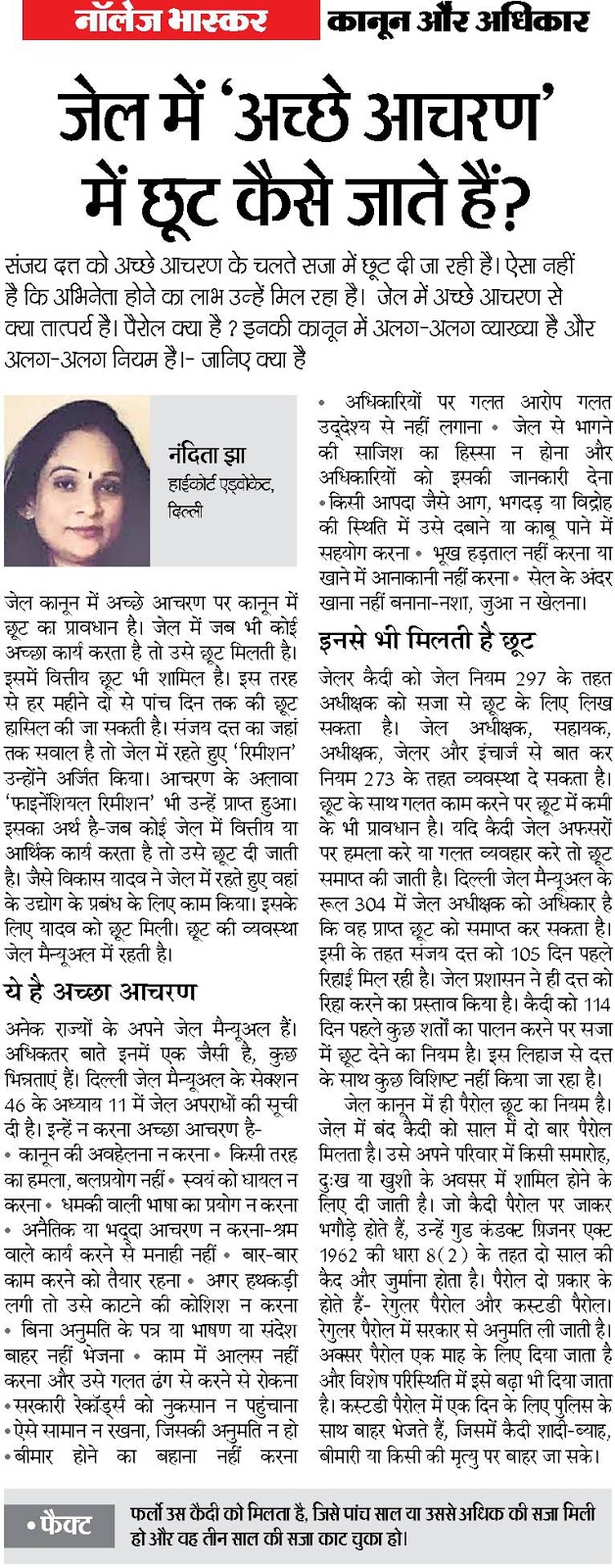
Good Behavior Results in Parole during Prison Time

Good Behavior Results in Parole during Prison Time

Sanjay Dutt is being granted parole for his good behavior. This is not because of him being an actor but it is a benefit that any inmate can get due to their good behavior.

What is parole? There are different rules, regulations, and definitions of it. Let us know more – 

Under the law, there is relaxation due to good behavior in prison time. Whenever someone has done a good work, they are provided with relaxation in time. Financial relaxation is also provided in this. In this way, 2 to 5 days of relaxation can be obtained each month.

In the case of Sanjay Dutt, he has obtained remission during prison time. In addition to good behavior relaxation, he also obtained financial remission. This means that whenever someone does financial or monitory work in prison, then they are provided with relaxation. For example – Vikas Yadav had worked for the management of small business during prison time. This provided relaxation to him. The proposal of relaxation during prison time is described in the prison manual. 

Points of good behavior -

Many states have their different prison manuals. Most of the points described in them are similar with some differences. Section 46 of chapter 11 of Delhi Prison manual has provided a list of crimes. When a criminal does not indulge in these crimes during prison time then this comes under good behavior. 

• Not disrespecting the law 
• Not hitting any one and not using any physical force 
• Not harming oneself physically 
• Not using any threatening language 
• Not indulging in illegal behavior 
• Not denying to do any physical work
• Not trying to take off hand cuffs
• Not sending any letters or message outside the prison without any permission
• Not showing any laziness in doing any work 
• Not harming the government records
• Not keeping anything that is not allowed
• No claims of being sick when actually healthy 
• Not putting any wrong accusations with wrong intentions on authorities 
• Not being a part of prison break by withholding information to authorities 
• Helping in natural calamities 
• Not indulging in hunger strike 
• Not cooking in the cell 
• Not indulging in any drug abuse 
• Not playing poker 

These points also provide parole -

As per rule 297, the jailer can write to the superintendent for parole of the criminal. The superintendent after discussing with assistant superintendent, jailer and in charge can provide parole to the criminal under the rule 273.

There can also be reduction in parole due to bad behavior. If the prisoner attracts the authorities or indulges in bad behavior, then the parole time can be taken away. As per rule 304 of Delhi prison manual, it is the right of the superintendent to end the parole time of any criminal.

In accordance, Sanjay Dutt has been granted a parole of 105 days earlier to his release date. The jail administration has decided to granted parole to him. There is a rule in which a prisoner can be given parole 114 days before his time when he agrees with some regulations. Therefore, in this case he has not been given any special treatment.  

Under the prison law, a prisoner gets parole twice a year. This is granted to them so that they can be with their family in good or bad times. Those prisoners, who go absconding during their parole time, are sentenced to 2 years of jail time and financial penalty under the section 8(2) of the good conduct prisoner act 1962. 

Parole is of two kinds – Regular and custody. Under regular parole, permission is taken from the government. Mostly parole is increased for a month and under special circumstances, it can be increased more. Under custody parole, the prisoner is sent with police protection for a day, during which he can attend a wedding or death ceremonies. 

FACT: Furlough is granted to those criminals who have completed 3 years of jail time out of five or more years.

Source #Advocate Nandita Jha, High Court -New Delhi 


Monday, 25 January 2016

Intuit India rolls out extended parental benefits to attract and retain quality talent

Intuit India rolls out extended parental benefits to attract and retain quality talent

IT and software firm Intuit India has announced a slew of benefits for employees in the early weeks of parenthood. The measures come on the heels of several companies in India stepping up efforts to attract and retain quality talent through progressive initiatives.
Flipkart, Adobe and Accenture are among the companies that have recently increased their maternity leave benefits. "As an employee-focused company, we want to create the best possible work environment that is simultaneously value-driven. Our employees are our most important asset, and we want to be able to provide them the necessary support so that they can do their best work without compromising on the work-life balance," said Vijay Anand, SVP and MD, India Development Cente.


Recently, the labour ministry approved a proposal from women and child development minister Maneka Gandhi to increase maternity leave in private companies to 26 weeks from 12 weeks, at present. This puts India on a par with several countries across the globe; some countries like Britain give a year off to parents of newborn children.

Under the new benefits rolled out at Intuit from January 1, paid maternity leave has been increased to 26 calendar weeks from 12. Paternity leave, earlier given for five working days, will now be given for 15 working days. Adoption leave will also be provided for 26 calendar weeks from the previous 12. Adoption leave is agnostic of gender and will be provided to all employees adopting children - whether male or female - so long as they are the primary caregiver of the child.
"Employees should not have to slow down their professional careers when embarking upon motherhood or fatherhood, and we see it as our responsibility to provide them the enabling environment to take sufficient leave as required," said Somnath Baishya, director-HR at Intuit.
The changes have been rolled out after consultation and brainstorming with employees, said Shikha Verma, C&B leader, India and APAC. "In urban nuclear families, a strong support system can be difficult to come by. Extended maternity and paternity leave give new parents the chance to bond with their baby and enjoy the onset of parenthood without added responsibility," she said.
The new benefits are part of the #GotYouCovered campaign, and are aimed at not only helping employees celebrate parenthood with time off, but also address the increasing parental responsibilities new fathers take on after a child's birth.
Intuit has about 930 employees at its Bengaluru office, and enjoys a gender diversity ratio of 38%, with 27% of the tech workforce and 33% of the leadership roles occupied by women. This apart, to make the transition back to work smooth, Intuit offers work flexibility through telecommuting and flexi-time options.
"Welcoming a new child into the family, either through birth or adoption, is the start of an exciting new chapter in life. Time to bond with and care for the new child (or children), and adjust to the change, is immensely important," employees were told in a mailer dated January 11 to announce the new benefits programme. ET has seen the mail.
"A happy and engaged workforce is a productive workforce, and that happiness stems from trust. Trust that your company has your back when you need it most, and this is the kind of trust we're building with our new policy," said Sriniwasan Ramaswami, talent engagement leader, India and APAC.

Thursday, 21 January 2016

180 days maternity leave in surrogacy cases - Maharashtra

Maharashtra first state to grant 180 days maternity leave in surrogacy cases 

Maharashtra will be the first state in the country where women employees in government jobs can avail up to 180 days’ maternity leave while having a baby through surrogacy. 

While several courts across the country have in recent months ordered that such leave be granted in specific cases, the state government is the first to issue a government resolution to the effect. 


The women employees will have to apply in advance to the authority concerned who will decide on the applications. The women employees will need to furnish certificates provided by the authorities according to the surrogacy guidelines of the Indian Council of Medical Research. 

The leaves will be applicable from the date of the child’s birth and will be granted only once in the employee’s tenure of service. All employees working in the state’s educational institutions and universities can also avail this benefit. 

The existing maternity leave rules provide for 180 days’ maternity leave to pregnant women and 90 days for women adopting children. The Bombay High Court had ruled last year that even a mother having a child through surrogacy was entitled to maternity leave.

Wednesday, 20 January 2016

Infy lets employees ‘work from home’ for 9 days in a month

Infy lets employees ‘work from home’ for 9 days in a month

Infosys has made another set of changes to its HR policy, in an effort to remain attractive to its employees, arrest attrition and drive productivity.


The country’s second largest software exporter has allowed its employees five extra days in a month, to ‘work from home'. With this, employees can work 9 days in a month from their home, compared to 4 in the past. Infosys HR sent an internal email to all employees a few days ago.

Considering the kind of hassle that employees go through commuting to and fro, often travelling an average of 90 minutes one way, employees had asked the company HR to be more flexible when it comes to its work out of home policy. “This will also go a long way in enhancing employee productivity as well as maintain a better work-life balance,” the note added.

Infosys is taking these measures for a couple of reasons, opine industry watchers. The first has to do with the fact that the bulk of the 1.8 lakh employees, in their twenties are very vocal about flexibility, in the way they work. Secondly, efforts like these will go towards curtailing attrition, which according to Sikka has been steadily coming down since he took over. In October, Infosys appointed Krish Shankar, a former Philips executive as its global HR head with a mandate to handle a different kind of workforce.

Also, this development comes six months after Sikka first announced the decision to do away with the policy of casual wear only on Fridays. Instead, he advocated employees to flaunt their business casuals all week. Similarly, immediately after taking over, Sikka relaxed the company's long-held rule that said employees needed to wear ties, after a number of employees asked him to scrap this rule.

Attrition down

In the third quarter, attrition in Infosys came on an annual basis came down to 13.4 per cent from 14.1 per cent in the previous quarter. On a consolidated basis, attrition came down to 18.1 per cent from 19.9 per cent in the September-ended quarter.

The company reported a strong set of quarterly numbers and cheered the market by increasing FY16 revenue guidance to 12.8-13.2 per cent in constant currency terms, and 16.2-16.6 per cent in rupee terms on December 31, 2015 exchange rates.

Wednesday, 25 November 2015

Women’s Relative right to property under the Will

Women’s Relative right to property under the Will

In previous days, the Supreme Court in favor of those women who have lost their husbands due to death has given a big decision. This decision is very important for those women who have been turned out of their houses and who are suffering even when they have ancestral properties.

Under the guidance of Justice M.Y Iqbal, the Supreme court has made it clear that those women whose husbands are dead have full right in the ancestor property and this is not just a formality but a relative and moral right of the woman. The woman is entitled to any property given to her under the will. She can give or sell this property to any party she wishes to. 

A women’s livelihood is the duty of the husband. If there is property in husband’s name then the wife has full right to use the property under the law. This is neither a formality nor pity but a proper relative right of the wife. And now the property and possessions will not only be given to other will holders but to the wife. 

This decision has come with the case of Jupudi Pardha Sarathi’s appeal who bought the house from P Venkat Subba’s son. Subba had three wives. Subba had given one of his properties to his third wife Veeragdhawama in 1920. She had no children. She gave the property in will to Pentapati Subbaro in 1971. After Veera’s death, Subba’s second wife’s son sold the property to Sarathi. The court had given decision that it was not wrong for the women to have sold the property, as it was her right by will and it will be passed to her male will holders after her death. But Andhra Pradesh’s high court had changed the decision of Lower court fully. According to high court, this case comes under the section 14, 1. According to court, Veera had become the full owner of the property by will and she had full right to will it to P Subbarao. The Supreme Court has agreed this decision. 

Even after remarriage, her right in dead husband’s property cannot be taken away from the woman. In addition, those women whose husbands are dead will be seen as the will holder and will have their share in the property like the son and daughter of the family only. Under the law of 1956, there was no provision for the share of the daughter in the ancestral property. But this has been amended in 2005 and now the daughter and the son are both equal recipients of the share. 

Under the punishment law 1973, there are many provisions for the safety of the women. Under section 125, the husband is responsible for the livelihood of the wife. If her husband leaves her or divorces her then she is entitled to alimony by first class magistrate orders. In August 2012, the Supreme Court had given orders that the government should see to the last rites of those women who are living alone in Vrindawan. The court gave suggestion to the government that Sulab international can be asked for help, which is an institution helping people, and women who are all alone. As after their death, no one comes forward for their last rites too. 

The government gives Rs 150 pension monthly to those women whose husbands are dead or left them and they are staying alone.  

From - Nandita Jha, High Court Advocate - Delhi

Women’s Relative right to property under the Will


Monday, 9 November 2015

Hindu Marriage Act - sec 3 and section 7

Legality of marriage does not need many proofs
Hindu Marriage Act - sec 3 and section 7

Many women feel inapt or stressed when it comes to proofs of marriage but the law says that even a photograph or some witness at the time of marriage is enough to prove the legality of marriage.

A case of Ratnagiri Maharashtra is evident here to quote. A couple got married in past in Ratnagiri. Since both were from the village, there were both parties from girl and boy side present during the ceremony. The pujari of temple performed the marital rites. Later the panchayat was informed and it was put in the village records. In addition, a witness from both sides was taken and was illustrated on a stamp paper. The husband Harish came to Mumbai for work and became a fitness trainer in a high-class gym. The wife sumitra was in the village. After just a year and half of marriage, Harish stopped communicating with Sumitra. He decided to leave her after 4 years of marriage since he was with a rich women in Mumbai who was helping him to open his own gym. Harish told Sumitra that the village marriage was not valid and it will not be considered valid in the city. Then sumitra approached the lawyers since she also felt that her marriage was not valid and she was living with her husband on wrong pretext. 

However, the lawyers told her about the details of Hindu marriage act 1955, sec 3. 

The sec 3 of Hindu marriage act 1955 says – 

All the traditional customs and rituals have been going on for decades and so they are equivalent to rules and laws. What are rituals or customs? In law language, a ritual is some rule, which has been going on for years and is used every time. It is not invalid in any case and if it is applicable to people and families and locals then it is to be accepted. 

That is why the law takes in course all the religious customs and traditions and rituals which have been going on forever. In this context, there is no specific definition of marriage. 

Section 7 of Hindu marriage act says – 

The Hindu marriage can be celebrated like a festive as per traditions and rituals of one’s caste and creed. The saath phears (seven rounds) are the main part of such marriages. Even the marriage in temple is valid. Then the question arises as to why these rituals and customs are seen for their legal validity in the book of law. Since India is a big country and there are many castes and creeds here, likewise these customs are accepted in the eyes of law too.

Therefore, Harish was wrong in saying that the marriage was invalid. Sumitra is not in any dilemma now, as she knows her marriage is valid. In our country, marriage is a religious custom and not only joining of two people legally. 

The law has given a diverse definition in case of witness or proof of marriage. If there are no other proofs left except photo of marriage or witness at time of marriage then also the marriage is considered valid. This important information can help many women from being misdirected.

Hindu Marriage Act - sec 3 and section 7,
Hindu Marriage Act - sec 3 and section 7, 


Advocate Vandna Shah, Family Court - High Court 

Wednesday, 21 October 2015

No more Divorce - Mumbai family court

Think before filing Divorce Application

Living together after divorce is heard and seen of in Bollywood but it is not so the case in real life. At the same time before divorce, everyone has the right to take back the divorce application and the law appreciates this step too.

Divorce is no good to anyone. People think that by divorce they get to win but it is not so the case. Many marriages in which there are problems do the individual problems finish after the divorce.

Mumbai family court is known for its positive attitude and a new concept regarding joining the couple back and not emphasizing on break up or divorce. A family court in Bandra converted the atmosphere of court from negative to positive and like a form of event or gathering and thus the couples feels positive about their relations again. Around 100 couples changed their mind here and saved their marriages.

In the case of Suchita, the couple decided to get divorce after 8 years of marriage and a child. The main problem being that the husband wanted to live his life on the ancestral property only and did not want to work. Therefore, the wife had to ask money for everything from his parents. This created rifts in between them. In the end, being a professional commercial artist the wife started her own studio in her in laws house only and soon she succeeded in her work and started earning her livelihood well and thus saved her marriage with her decision of staying back and working from her husband’s ancestral home. 

In another case, a diamond merchant had decided to divorce his wife who was middle school pass. Then the wife relocated from Gujarat to Mumbai opened her own Tiffin center and challenged the divorce petition. After three years of long process of court when their divorce papers were finalized they both decided to meet each other without distraction before signing the papers for 2 days and in those two days both of them recoincilated and took away their divorce petition And save their marriage. 

A wrong notion in the society is that once a divorce petition has been entered in the court it cannot be taken back which is very wrong. The prosecutors and lawyers etc should be the ones to make people more aware bout their rights. 

The petition to take back the divorce petition can be submitted to the family court. Once it reaches the councilor then both parties have to make it evident before the councilor that they both are ok with taking away the divorce petition and this is done to safeguard both of them and to see if anyone is doing this under pressure. Then this petition is sent to the judge and he/she gives the decision in one day or decree. Everyone including the judge and councilor are always in favor of making people realize as to not break their marriage in India.

Thursday, 8 October 2015

Earning rights are part of living rights

Under sec 25 F of Industrial dispute act 1947, some important decisions have been taken. 

Management has been asked to take the workers back on work with full settlement of unemployment salary. Judge V Gopalagora gave the decision in a case of up state and charansingh that constitutional rights 19 and 21 have not been complied as they clearly state the freedom right of earning and living. The family members are suffering as the earning capacity has been taken away from the worker. In another case of Olga Talis and Mumbai Municipal Corporation the judge quoted that is the right to earn a part of right to live and the answer is yes. 

Sec 21 of constitution is very wide in its thought process. The right to live is not only limited to death penalty it is associated with right to earn also as no one can live without ability and capacity to earn livelihood. Therefore, if a person is devoid of its capacity to earn livelihood then it is a direct impact on its right to live. This is inhuman and is major cause of village population to migrate to cities. 

In another similar case the fact were as follows. Charan Singh was appointed as tube well operator in fisheries department on 6 march 1974. He was fired on 22 august 1975 by quoting the reason that since he was kept temporarily now there is no use of him further. Charan Singh took the matter forward to court. 

The court asked the management to appoint the person back on 24 Feb. 1997 but he was not given any backlog of salary of past. He was given the fisherman’s post quoting that its equivalent to tube well operator but he had not come to work for that job. The management applied to high court at Allahabad that no salary will be given from 24 Feb. 1997 to 31 Jan 2005. However, the court quoted and gave verdict against the management saying that they wasted so many years of the worker and he should be given his rightly due in four weeks. Supreme Court also voted for with this verdict of Allahabad high court and agreed to the righteous salary from 24 Feb. 1997 to 31 Jan 2005.

Earning rights are part of living rights